The Art of Storytelling in the Age of Slop

We're drowning in content. AI has made it cheaper than ever to produce words, decks, emails, and pitches at scale. The result? A sea of sameness polished on the surface, hollow underneath. This is the age of slop.

And in the age of slop, the single greatest competitive advantage an agency has is the ability to tell a real, human, emotionally resonant story.

Why story still wins

Humans have been wired for narrative since before writing existed. We don't remember facts. We remember stories. The structure a person, a problem, a journey, a resolution is how we make sense of the world.

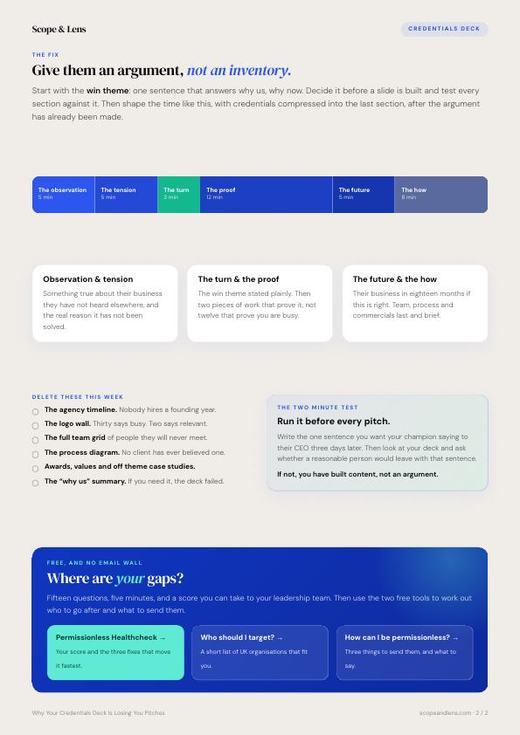
In a pitch context, this matters enormously. A client sitting across the table from five agencies isn't going to remember the one with the best credentials slide. They're going to remember the one that made them feel something.

Your most valuable asset is your ability to deliver results. Your biggest vulnerability is their belief in that ability.

The framework: Situation, Complication, Resolution, Better Future

Every great pitch follows a version of this arc. You start by establishing the world as it is the Situation. Then you introduce the tension the Complication. You position your agency as the path through that tension the Resolution. And you paint a vivid picture of the world on the other side the Better Future.

This isn't just a nice narrative device. It's a decision-making framework. Clients buy the future, not the agency. They buy the outcome, not the process. Story is how you make that future feel real and achievable.

What to do about it

Before your next pitch, ask yourself: what is the one problem this client is losing sleep over? Not their marketing problem. Not their business objective. The thing that keeps their CMO awake at 2am.

Now build your pitch around that. Lead with their world, not yours. Introduce the tension they feel every day. Show how you resolve it. And make the Better Future so tangible they can almost taste it.

That's story. That's what wins pitches. And in the age of slop, it's rarer and more valuable than ever.

Enjoying this? Subscribe to the Scope & Lens newsletter on LinkedIn for weekly thinking on agency new business.

Subscribe on LinkedIn →

Why Most Agency Pitches Fail Before They Begin

Most agencies think pitching starts when they get the brief. It doesn't. By the time you're in the room, the client has already formed an impression of you and often, already has a preferred agency in mind.

The pitch is just the confirmation of a belief they formed long before the meeting. Which means the real pitch happens before the pitch.

The pre-pitch is the pitch

Think about how clients actually choose agencies. They don't wait for a brief to drop and then cold-search for options. They tap into their networks. They think about agencies they've seen doing interesting work. They remember the person who sent them something useful three months ago.

Relationships and reputation are built long before an opportunity exists. And agencies that understand this don't wait for briefs they earn the right to be considered before the brief is even written.

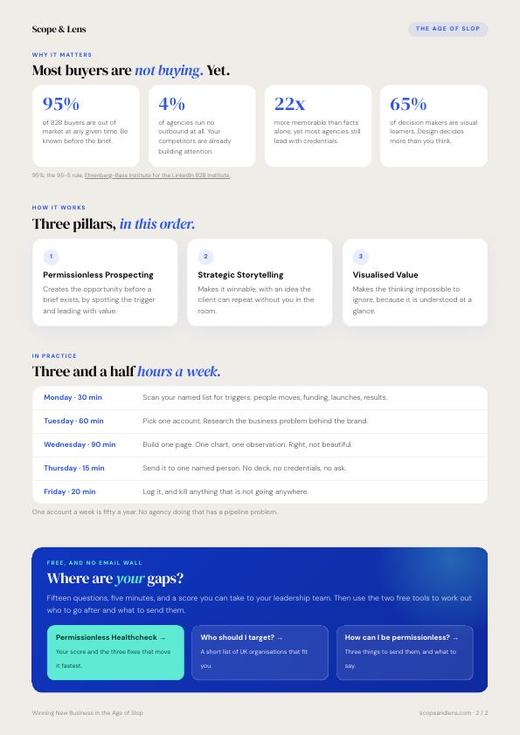
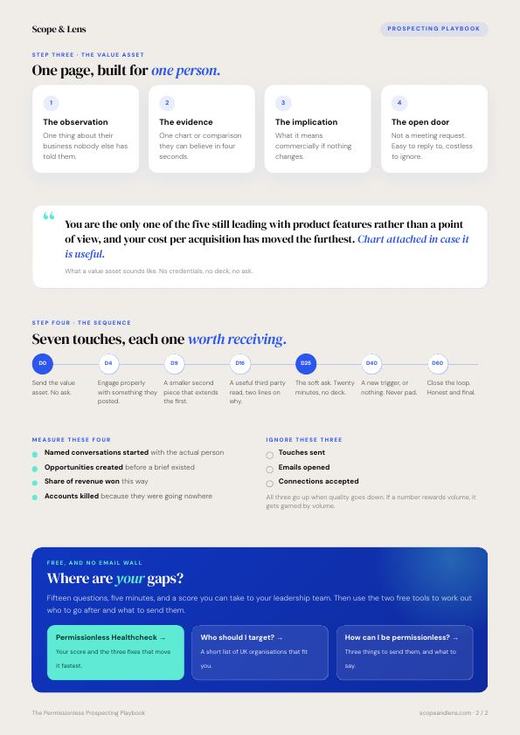
Permissionless prospecting isn't about selling. It's about showing up with value, consistently, until you're the obvious choice when an opportunity arrives.

What to do instead

Stop treating new business as a reactive process. Start treating it as a relationship-building discipline. Identify the 20 clients you most want to work with. Learn everything about their business. Then show up not with a credentials deck, but with a point of view. An idea. A piece of thinking that's genuinely useful to them.

Do that consistently, over months, without asking for anything in return. When a brief arrives, you won't be a new agency. You'll be the only obvious choice.

Enjoying this? Subscribe to the Scope & Lens newsletter on LinkedIn for weekly thinking on agency new business.

Subscribe on LinkedIn →

Your Slides Are Costing You Clients

You've done the thinking. You've built the strategy. You've rehearsed the story. And then you open the deck and the room switches off.

It happens more than agencies realise. Not because the ideas are weak, but because the slides are working against them. Poor visual design doesn't just look bad. It actively destroys attention, undermines credibility, and makes even brilliant thinking forgettable.

The brain doesn't read. It scans.

Here's a fact that should change how you build every slide you ever make: the human brain processes images 60,000 times faster than text. Not a little faster sixty thousand times faster.

What that means in a pitch room is brutal. While you're talking through a slide crammed with bullet points and body copy, your audience has already made a judgment. They've looked at the slide, decided it's dense and hard work, and mentally checked out all before you've finished your first sentence.

Attention research is unambiguous on this: we are visual creatures first. We don't read presentations, we experience them. And if that experience requires effort, we disengage.

65% of your audience are visual learners

Roughly two thirds of people process and retain information most effectively through visual means. Not through reading. Not through listening. Through seeing.

Which means the majority of the people sitting across from you in a pitch the ones whose votes you need are going to remember what they saw far more vividly than what they heard or read. A powerful image, a clear diagram, a well-designed data visualisation: these don't just look good. They are your argument, made in a language the brain is wired to receive.

Your slides aren't a support act. For most of your audience, they are the pitch.

Cognitive load kills credibility

When a slide contains too much too much text, too many competing elements, too little white space the brain experiences what psychologists call cognitive overload. It's not that the audience is disengaged or uninterested. It's that you've made their brain work too hard just to process what's in front of them, leaving no mental capacity to absorb the actual idea you're trying to land.

Ironically, the agencies that pack the most into their decks under the belief that more content signals more rigour are often the ones who leave the least impression. The audience is exhausted, not impressed.

The best pitch decks do the opposite. They remove everything that isn't essential. They use visual hierarchy to direct attention. They give each idea room to breathe. And they trust that a clean, confident slide communicates authority far more effectively than a dense, cluttered one ever could.

Design for a glance, not a read

The principle that changes everything is this: design every slide as if the audience will only look at it for three seconds. Because many of them will.

In those three seconds, what do they see? Is there a clear focal point? Is the single most important thing instantly obvious? Or are their eyes bouncing around, unsure where to land?

If you can't answer those questions confidently about every slide in your deck, your design is working against you.

The good news is that this isn't about making things pretty. It's about making things clear. Visual design principles hierarchy, contrast, whitespace, alignment are attention management tools. They tell the brain where to look, what matters most, and what to remember. Use them deliberately, and your ideas don't just get seen. They get felt.

What this means for your next pitch

Before you add another bullet point to a slide, ask yourself whether it's earning its place. Not whether it's accurate or relevant but whether it's helping the room understand and remember your idea, or adding to the noise they're already trying to filter out.

The agencies that win pitches consistently aren't the ones with the most content. They're the ones whose thinking is clearest and whose slides make that clarity impossible to miss.

Enjoying this? Subscribe to the Scope & Lens newsletter on LinkedIn for weekly thinking on agency new business.

Subscribe on LinkedIn →
Start a conversation →
Practice Playbooks Programme Writing Let's Talk
A practice. A programme.

Help them
choose you.

Stop selling harder. Start showing up with something worth paying attention to. We help agencies grow through permissionless value, storytelling and design, so the right clients choose you before they've met the competition.

0+ Years of pitching experience
£0M+ Revenue generated for agencies
0+ New business pitches delivered
Brands we have pitched to
Netflix
Kellogg's
Disney
Nestlé
Ferrero
Red Bull
BBC
eBay
Jo Malone London
NatWest
OVO Energy
Santander
Wowcher
New Look
Utilita
M&S
Netflix
Kellogg's
Disney
Nestlé
Ferrero
Red Bull
BBC
eBay
Jo Malone London
NatWest
OVO Energy
Santander
Wowcher
New Look
Utilita
M&S

Done with you.
Or done by you.

The Practice

Work with me directly.

Hands-on growth consulting across prospecting, pitch narrative and visual design. I build the system, embed it in your team, and stay in your corner through the pitches that matter most.

  • Growth Sprint, Fractional Lead or revenue share
  • Built around your stage, not a template
  • Senior support without a senior hire
Work with the practice →
The Programme Coming soon

Learn to do it yourself.

The productised version of the practice. A course that hands your team the exact frameworks behind 100+ pitches, so you can run a permissionless growth engine without me in the room.

  • Permissionless prospecting, end to end
  • The storytelling and design playbook
  • Self-paced, built for new business teams
Join the waitlist →

Three lenses.
One goal.

01
Permissionless Prospecting

Replace generic outreach with value-led, highly relevant prospecting that builds relationships before a brief exists. The goal is connection, not conversion.

you them value + belief

Connections and pitch wins live at the intersection of your value and their belief

OutcomeMore qualified, high-value opportunities entering the pipeline
02
Strategic Storytelling

Structure your pitch around a narrative arc that moves people emotionally as well as logically. Stop pitching capabilities. Start pitching transformation.

Story
22x
Fact
1x

Stanford research shows stories are remembered up to 22x more than facts alone.

OutcomeStronger differentiation and higher pitch conversion rates
03
Visualised Value

Apply visual design principles and attention research to construct a pitch that grabs attention and keeps it. Your slides aren't decoration. They're the difference between an idea that lands and one that's forgotten before you leave the room.

65% of people are visual learners

IMAGE TEXT 60,000x

The brain processes images 60,000x faster than text

OutcomeMore memorable pitches with stronger visual recall

Built around
your stage.

Project
Growth Sprint

End-to-end growth consultation across prospecting, pitch narrative and visual design. We build the system, embed it in your team through workshops, and provide unlimited pitch support throughout.

Retainer
Fractional Growth Lead

Your always-on commercial partner. Ongoing strategic counsel, prospecting engine development and on-call pitch doctor for founders and new business teams who need senior support without a senior hire.

Revenue Share
Let's Win Together

For high-stakes pitches where you want a dedicated pitch doctor in your corner. I work on the narrative, flow, design and rehearsal and share in the upside of pitches I help you win.

Work with the practice →
The Playbooks

Two free tools.
Zero cost.

Built from 100+ pitches and 30M+ in agency revenue. Use the playbook to learn the frameworks. Take the assessment to see where you stand.

Agency Growth Playbook
The 3-part framework most agencies are missing, covering prospecting, storytelling and visual design.
Free
01Permissionless Prospecting
02Strategic Storytelling
03Visualised Value
Enter your email to access

No spam. Just the playbook.

You're in. The playbook is ready.

Open the Playbook
Growth Assessment
Answer 15 questions across the three pillars and get a scored breakdown of where your agency is winning, and where you're leaving pitches on the table.
Free
15Questions across 3 pillars
Personalised recommendations
Take the free assessment
The Programme Coming soon

Learn the method.
Run it yourself.

The productised version of my consulting. A self-paced course that teaches your team the exact prospecting, storytelling and design frameworks I use to help agencies win, so you can build the system without me in the room.

Permissionless Prospecting Strategic Storytelling Visualised Value Pitch rehearsal and delivery
Join the waitlist →

Ideas worth
pitching.

01 Prospecting
Edition 1 · February 2026
Why Most Agency Pitches Fail Before They Begin
By the time you're in the room, the client has already formed an impression of you. The real pitch happens before the pitch.
Read article
02 Storytelling
Edition 2 · February 2026
The Art of Storytelling in the Age of Slop
In the age of slop, the single greatest competitive advantage an agency has is the ability to tell a real, human story.
Read article
03 Design
Edition 3 · February 2026
Your Slides Are Costing You Clients
65% of decision makers are visual learners. Here's what that means for your pitch deck and how to fix it fast.
Read article
Read on LinkedIn

Start free

Download the Agency Growth Playbook and take the Growth Assessment. No cost, no catch.

Explore the playbooks →

Work with the practice

Bring me in for a sprint, a retainer, or a single high-stakes pitch you need to win.

Start a conversation →

Ready to win
more of the right pitches?

Tell me a little about where you are and what you're trying to fix. I'll come back to you within 48 hours.

Thanks I'll be in touch.

Expect a reply within 48 hours. Follow Scope & Lens on LinkedIn in the meantime.